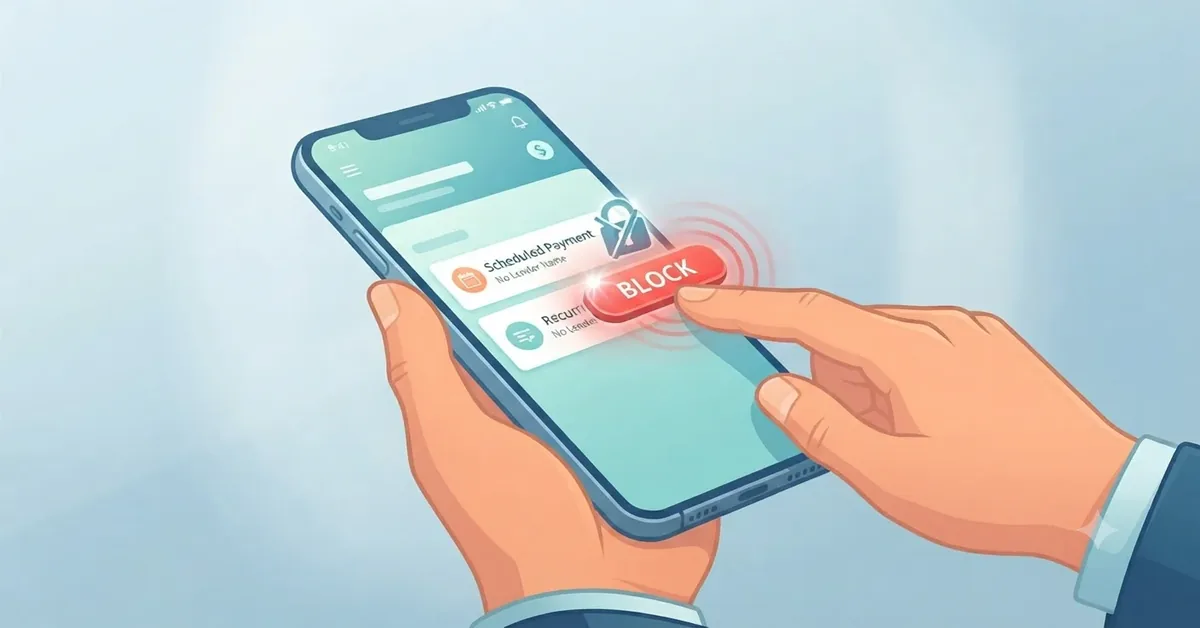
Bright Lending's ACH auto-debit withdraws payment directly from your bank account on each scheduled payment date. If you're facing financial hardship, need to stop the withdrawals to regain control of your cash flow, or simply want to manage payments on your own terms, you have the legal right to do so.
This guide gives you the exact steps, the letter templates, and the legal basis for revoking ACH authorization — for both the lender and your bank.
Your Legal Right to Revoke ACH Authorization
Under the Electronic Fund Transfer Act (EFTA) and its implementing regulation (Regulation E), you have the right to revoke authorization for automatic payments at any time. This federal law applies to all ACH transactions — including those initiated by tribal lenders.
✓ Tribal sovereignty does not override the EFTA. The right to revoke ACH authorization is a federal right that exists regardless of whether the lender operates under tribal law, state law, or federal law. The FTC has specifically confirmed this applies to tribal lenders.
Revoking ACH authorization does not cancel your debt — you still owe the principal and any accrued interest. What it does:
- Stops Bright Lending from automatically withdrawing from your account
- Prevents NSF fees from failed ACH drafts
- Gives you control over when and how much you pay
- Protects your bank account from overdraft if you're in financial hardship
The Two-Track Approach: Lender + Bank
For maximum protection, notify both Bright Lending and your bank. Each track provides different legal protections:
| Track | Who You Notify | Effect | Timeline |
|---|---|---|---|
| Track 1 | Bright Lending (written notice) | Revokes ACH authorization with the originator | 3 business days before next payment |
| Track 2 | Your bank (stop payment order) | Blocks the specific ACH debit at the bank level | Before the payment processes |
| Track 3 (optional) | New bank account | Eliminates the risk entirely | Takes 1–3 days to set up |
Track 1: Written Notice to Bright Lending
Under the EFTA, you must notify the company of your revocation at least 3 business days before the next scheduled payment. The notice must be in writing to be fully protected.
Send via certified mail with return receipt AND by email to cs1@getbrightlending.com to create a documented paper trail.
[Your Full Name]
[Your Address]
[City, State ZIP]
[Date]
Bright Lending / Aaniiih Nakoda Finance, LLC
Customer Service Department
[Bright Lending's Address]
RE: Revocation of ACH Debit Authorization — Loan Account #[YOUR ACCOUNT NUMBER]
Dear Bright Lending Customer Service,
I am writing to formally revoke my authorization for automatic ACH debits from my bank account in connection with the above-referenced loan account, effective immediately and for all future payments.
Under the Electronic Fund Transfer Act (15 U.S.C. § 1693e) and Regulation E (12 C.F.R. Part 1005), I have the right to revoke this authorization at any time. This notice serves as my written revocation as required by law.
Bank account information previously authorized:
Account holder: [Your Name]
Bank name: [Your Bank]
Account type: Checking / Savings
Last 4 digits of account: XXXX
Please confirm receipt of this revocation in writing. I understand that revoking ACH authorization does not cancel my outstanding loan obligation, and I intend to fulfill my payment responsibilities through an alternative method.
Any further ACH debits to my account following receipt of this notice will be considered unauthorized transactions subject to dispute under federal law.
Sincerely,
[Your Signature]
[Your Printed Name]
[Phone / Email]
Track 2: Stop Payment Order at Your Bank
Contact your bank at least 3 business days before the next expected ACH draft. You can do this:
- In person at a branch (fastest, most reliable)
- Via phone (get a confirmation number)
- Via online banking or mobile app (if your bank supports ACH stop payments)
Tell your bank: "I need to place a stop payment on ACH debits from Bright Lending / Aaniiih Nakoda Finance, LLC. I am revoking their ACH authorization effective immediately."
What to provide your bank:
- The company name: Bright Lending or Aaniiih Nakoda Finance LLC
- Approximate payment amount (e.g., $140.22)
- Expected payment dates
- A copy of your written revocation notice to Bright Lending
ℹ️ Bank stop payment fees: Many banks charge $25–$35 for a stop payment order. Some online banks (Chime, Ally, SoFi) do not charge this fee. The cost is typically worth it to prevent a $140+ withdrawal plus NSF fees.
If an unauthorized ACH debit goes through after your revocation: Dispute it with your bank immediately. Under Regulation E, your bank must investigate and provisionally credit your account within 10 business days. An ACH debit that occurs after a properly sent revocation notice is an unauthorized transaction.
Track 3 (Optional but Effective): Open a New Bank Account
If you're concerned that stop payment orders may be insufficient, or if your current bank has a complicated stop payment process, the most reliable solution is opening a new checking account at a different bank or credit union — and receiving your next paycheck there instead.
Once Bright Lending's ACH drafts hit an account with no funds, the drafts will fail. You'll face NSF fees at first (one reason to combine this with the written revocation), but subsequent drafts to the original account will automatically fail.
Key considerations:
- Notify your employer of your new direct deposit information before the next paycheck
- Update any legitimate automatic payments (bills, subscriptions) to the new account
- Keep a small buffer in the old account if needed for outstanding checks
- Send the revocation letter regardless — this is the legally cleanest approach
What Happens After You Revoke ACH Authorization
Revoking ACH authorization changes how Bright Lending can collect — it does not eliminate the debt or stop interest from accruing. After revocation:
- Bright Lending will contact you by phone and email to arrange alternative payment
- Your APR may increase from the ACH rate (700%) to the manual rate (725%) since you are no longer on auto-pay
- You will need to make payments manually — by debit card, check, or other accepted methods
- Default and collections consequences remain possible if you stop paying entirely
For what happens if you stop paying entirely, see What Happens If You Default on a Bright Lending Loan?. For negotiating a settlement, see Step-by-Step Guide to Settling Your Tribal Loan Debt for Less.
Common Mistakes to Avoid
- Verbal revocation only: Calling to cancel is not enough — always follow up in writing to be protected under the EFTA.
- Waiting until the day of the payment: The 3-business-day rule means you need to act before the deadline, not on payment day.
- Assuming the bank stop payment is permanent: Bank stop payment orders sometimes expire after 6 months. Confirm the duration and renew if needed.
- Not keeping records: Save the certified mail receipt, the email confirmation, and the bank stop payment confirmation number.
- Stopping payment without a plan: If you stop ACH debits but don't make alternative arrangements, the debt grows. Revoke ACH as part of a broader plan, not as a standalone move.
Verdict
Our Verdict
Revoking ACH authorization is a legitimate, federally protected right — not a loophole. If you are in financial hardship, stopping automatic withdrawals gives you breathing room to manage your cash flow, avoid NSF fees, and make a plan for the underlying debt.
Do both tracks: send the written revocation to Bright Lending and notify your bank. Keep copies of everything. And remember that revoking ACH is the beginning of a debt strategy, not the end of it.